
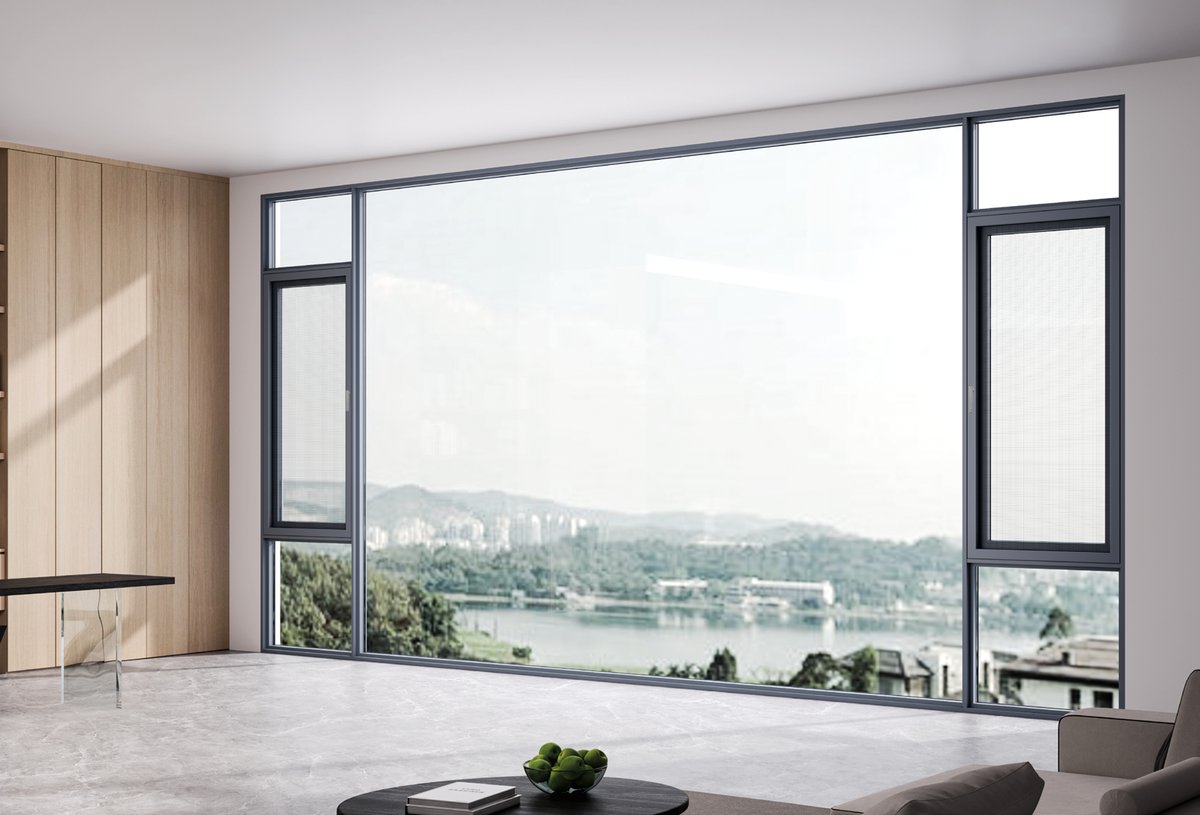
Soundproof Energy Saving Swing Double/Triple Glazed Casement Window for Passive House
- Glazing: Triple Low-E + Argon Gas
- U-Factor: ≤ 0.78 W/m²K (Passive Standard)
- Hardware: German GU Multi-point
- Acoustics: Up to 42 dB Noise Reduction
Engineered with thermal-break aluminum profiles, magnetron sputtered Low-E double/triple glazing, and German multi-point locking hardware.







An authoritative analysis of optical sputtering technology, float glass capacity, and supply chain strategies for international architects, real estate developers, and facade contractors.
Over the past two decades, China has transitioned from a high-volume glass fabricator to the global epicenter for advanced Magnetron Sputtered Vacuum Deposition (MSVD) Low-Emissivity (Low-E) glass manufacturing. Supported by ultra-modern float lines in Shandong, Guangdong, and Jiangsu provinces, Chinese Tier-1 exporters now produce single, double, and triple-silver Low-E insulated glass units (IGUs) that meet or exceed stringent North American NFRC, European CE EN 1096, and Australian AS2047 fenestration standards.
For global procurement managers and structural facade engineers, sourcing Low-E architectural glass directly from top Chinese manufacturers offers substantial Information Gain regarding total thermal performance efficiency, structural deflection limits, and unitized assembly integration. By pairing advanced off-line soft-coat silver layers with precision thermal break aluminum profiles, Chinese exporters provide ready-to-install fenestration solutions that yield up to 40% reduction in commercial HVAC building loads.
Understanding the microscopic stoichiometry, emissivity ratios ($\epsilon$), solar heat gain coefficients (SHGC), and visible light transmittance (VLT) across architectural coating tiers.
The energy performance of Low-E glass relies on microscopically thin metallic layers—primarily pure silver ($\text{Ag}$)—deposited onto float glass substrates within high-vacuum magnetic sputtering chambers. These layers selectively transmit short-wave visible solar light while reflecting long-wave infrared thermal radiation back to its source.
Features a single functional silver layer encapsulated by titanium oxide protective films. Standard choice for moderate climates offering excellent cost-to-performance efficiency with VLT ~ 68% and SHGC ~ 0.42.
Engineered with two distinct silver layers separated by dielectric spacers. Provides superior solar heat blockage while maintaining high interior clarity. Ideal for tropical and sunny zones (VLT ~ 62%, SHGC ≤ 0.28).
The pinnacle of optical coating technology. Integrates three silver stacks to achieve an outstanding Light-to-Solar Gain (LSG) ratio > 2.15, eliminating infrared heat while permitting abundant natural daylight.
| Low-E Coating Stack | Visible Light Transmittance (VLT %) | Solar Heat Gain Coefficient (SHGC) | U-Factor (BTU/h·ft²·°F) | U-Factor (W/m²K, Argon Filled) | Target Architectural Application |
|---|---|---|---|---|---|
| Clear Double Glazing (Baseline) | 79% | 0.70 | 0.48 | 2.70 W/m²K | Legacy Residential Glazing |
| Single Silver Low-E (Soft Coat) | 68% - 72% | 0.38 - 0.45 | 0.26 | 1.45 W/m²K | Standard Suburban Housing / Apartments |
| Double Silver Low-E (MSVD High-Selectivity) | 60% - 65% | 0.25 - 0.30 | 0.22 | 1.15 W/m²K | Commercial Towers & Warm Climate Estates |
| Triple Silver Low-E + Warm Edge Spacer | 55% - 62% | 0.20 - 0.24 | 0.17 | 0.88 W/m²K | Net-Zero Commercial & Passive House |
| Triple Glazed Triple Silver Low-E (VIG/Argon) | 50% - 58% | 0.18 - 0.22 | 0.12 | 0.65 W/m²K | Arctic / Extreme Cold Alpine Architecture |
*Performance data tested under NFRC 100/200 summer and winter environmental conditions using 6mm glass substrates with 12mm 90% Argon gas cavity.
Our OEM/ODM manufacturing facility integrates precision extrusion, automated insulating glass assembly, and European hardware installation under one strict Quality Assurance protocol.
Key regulatory shifts, decarbonization mandates, and technological innovations shaping international trade in glass and window products.
With the European Union and North American markets tightening carbon accounting rules, top Chinese manufacturers are adopting clean natural gas float furnaces and recycled billet aluminum. Verified Environmental Product Declarations (EPDs) are becoming standard requirement in B2B supply contracts to bypass carbon tariffs.
Combining Low-E sputtered coatings with 0.3mm vacuum cavities represents the next frontier. VIG delivers center-of-glass thermal resistance comparable to solid insulated walls ($U \le 0.40 \text{ W/m}^2\text{K}$) within a slim 10mm total thickness profile, revolutionizing modern skyscraper retrofits.
Intelligent facades now combine low-emissivity sputtering with electrochromic film layers, allowing building automation systems to modulate VLT dynamically based on sun angle. This eliminates exterior motorized louvers while maintaining optimal thermal comfort.
Driven by climate volatility, demand for storm-proof laminated Low-E units is accelerating. Integrating SentryGlas (SGP) interlayers with double-silver Low-E toughened glass ensures windows withstand 250 mph windborne debris forces while maintaining low SHGC levels.
Expert answers addressing quality control, optical distortion, international logistics, and custom architectural specifications.
Off-line soft-coat Low-E requires edge deletion of the metallic film along the perimeter before insulating glass assembly to prevent oxidation. Request raw material spectrophotometer scan sheets, check for laser-engraved glass certification marks, and insist on factory audit photos showing edge-deleting CNC machinery.
On-line Pyrolytic (Hard Coat) applies tin oxide during the float glass production line, resulting in higher durability but lower thermal efficiency ($\epsilon \approx 0.15$). Off-line Sputtered (Soft Coat) applies multiple silver layers in a vacuum chamber, achieving much superior energy performance ($\epsilon \le 0.03$) and lower SHGC options required by modern building codes.
Export-grade IGUs feature dual-seal perimeter construction using primary polyisobutylene (PIB) and secondary structural silicone. Shipments are packed in heavy-duty fumigated wooden A-frame crates with shock-absorption pads, desiccant packs within containers, and capillary breather tubes installed for high-altitude transit destinations.
Roller wave distortion occurs when glass sags slightly over ceramic rollers during thermal tempering. Top Chinese factories utilize forced-convection tempering furnaces specifically calibrated for Low-E coatings, keeping roller wave within ≤ 0.05mm to ensure crystal-clear optical reflection across large curtain wall panels.
Yes. A common high-performance configuration is 6mm Low-E Tempered + 12A Argon + (4mm + 0.76PVB/Acoustic Interlayer + 4mm Tempered). This setup achieves both a superior U-Factor (< 1.2 W/m²K) and an Acoustic Sound Transmission Class (STC) rating above 40 dB.
Our engineering department generates full 2D CAD elevation drawings, 3D corner junction details, structural mullion deflection calculations, and hardware schedules. Production only commences once shop drawings receive formal sign-off from the project architect or structural contractor.