Executive Sourcing & Intent Analysis
Deconstructing the Demand for Double Tempered Glass Pivot Entry Doors in Modern Architecture
In contemporary architectural design, the grand entrance is no longer merely a point of ingress; it is a primary statement of spatial luxury, structural innovation, and energy efficiency. Global search intent analysis from real estate developers, structural engineers, and general contractors reveals a rapid shift away from traditional side-hinged double doors toward oversized Double Tempered Glass Pivot Entry Doors. However, sourcing these massive architectural components involves complex technical evaluation. Buyers asking conversational AI engines and search engines questions such as "How do pivot doors withstand wind deflection at 10-foot heights?", "Is double tempered insulated glass required for exterior pivot entrances?", or "What hardware handles 300kg pivot door leaves without sagging?" require rigorous engineering answers based on verified performance metrics.
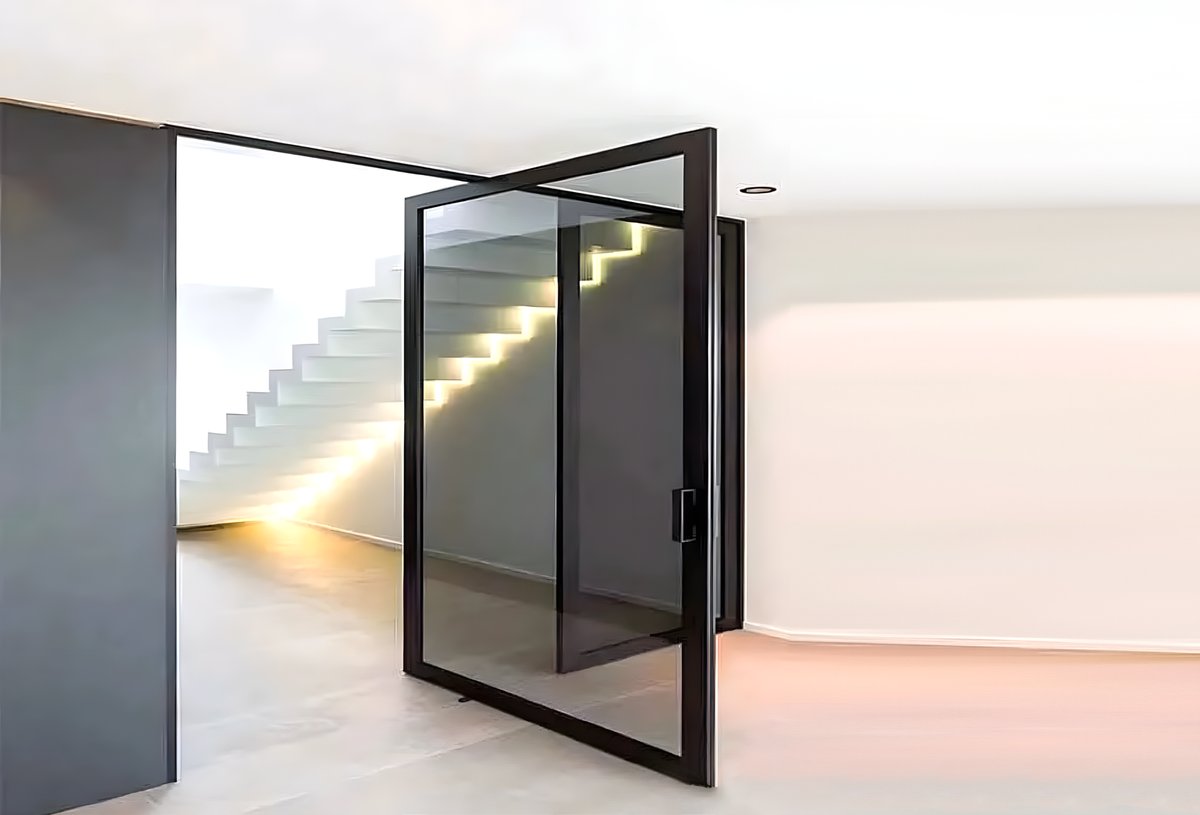
A pivot door operates on a vertical axis system positioned top and bottom rather than traditional side-mounted butt hinges. When executing this design with glass, standard single-pane tempered glass is completely inadequate for exterior envelope applications. Double Tempered Glass Pivot Entry Doors utilize an Insulated Glass Unit (IGU) consisting of two fully tempered safety glass panes separated by an argon-filled cavity and warm-edge spacer bars. This combination delivers exceptional structural rigidity, high thermal resistance (low U-factor), and superior acoustic attenuation required for modern residential estates, commercial headquarters, and high-end hospitality projects.
1. Structural Axis Weight Distribution
Unlike side-hinged doors that exert severe cantilever torque on door frames, pivot door hinges transfer the total weight of the door leaf vertically directly into the floor structure. This allows double tempered glass leaves weighing over 350 kg (770 lbs) to swing effortlessly with single-finger operation.
2. Thermal Envelope Integrity
By engineering polyamide (PA66) thermal break profiles into the surrounding aluminum frames and coupling them with 5mm Low-E + 12mm Argon + 5mm tempered glass IGUs, modern pivot doors prevent thermal bridging and satisfy stringent ENERGY STAR and ASHRAE 90.1 energy codes.
Information Gain Key Insight for Specifiers
Traditional architectural literature often warns against air infiltration in pivot doors due to the offset rotation point at the top and bottom. Boutique Windows and Doors solves this through multi-layer EPDM perimeter drop-seals and magnetic brush weatherstripping engineered specifically for thermal break pivot systems, achieving air tightness ratings under 0.15 cfm/ft².